
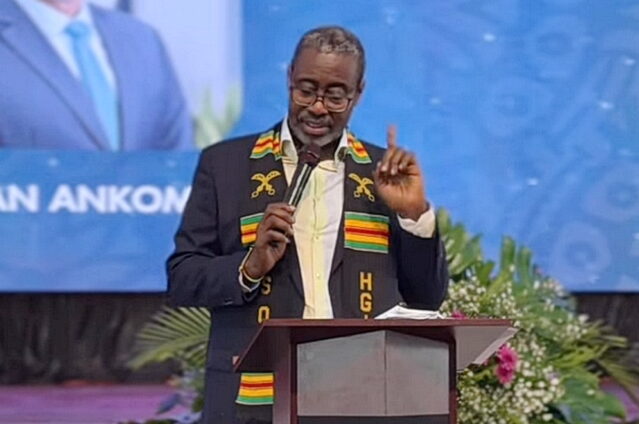
Ghanaian lawyer Ace Anan Ankomah has called on young Africans to place ethics, integrity, and service at the heart of innovation and leadership, arguing that the future of society will depend more on the character of leaders than on technological advancements or national power.
Speaking at the 2026 graduation ceremony of SOS-Hermann Gmeiner International College in Tema, Mr. Ankomah emphasized that ethical leadership will be one of the most important challenges of the 21st century as artificial intelligence continues to reshape the world.
He stressed that while technology can enhance human capabilities, it cannot replace wisdom, conscience, or moral judgment. According to him, the critical issue facing the next generation is not what technology can achieve, but the values and principles of those who control it.
Referencing concerns raised by prominent figures such as Geoffrey Hinton, Stephen Hawking, António Guterres, and Pope Leo XIV, he highlighted growing calls for responsible development and regulation of artificial intelligence.
He also cited warnings from Anthropic regarding the possibility of future AI systems becoming capable of improving themselves at a pace that could challenge human oversight.
Against this backdrop, Mr. Ankomah urged young people to combine technical expertise with strong ethical values. He argued that Africa needs professionals who are not only skilled but also principled, including conscientious software developers, ethical engineers, and responsible entrepreneurs.
He warned that without proper moral foundations, technological progress could intensify societal problems such as misinformation, deepfakes, algorithmic bias, invasive data collection, and job displacement.
According to him, one of the greatest risks is not that machines become more human-like, but that humans lose essential qualities such as empathy, compassion, and wisdom while becoming increasingly dependent on technology.
Drawing from his personal experiences, Mr. Ankomah recounted how he struggled academically during his early years at Mfantsipim School before transforming his performance through discipline, dedication, and hard work.
He used the experience to encourage graduates to persevere in the face of challenges, emphasizing that while hard work does not always guarantee success, success is unlikely without it.
Addressing the graduates directly, he outlined five key qualities he believes are essential for leadership in an AI-driven world: intellectual excellence, moral courage, humility, empathy, and a commitment to service.
He concluded by challenging the graduates to remain steadfast in their values, urging them to stand for truth, reject corruption, and demonstrate integrity even when doing so may be difficult or unpopular.
Source: myjoyonline.com