
Ghana has officially unveiled a nationwide framework aimed at accelerating support for vulnerable populations during emergencies, as authorities warn that climate shocks, economic downturns, and public health crises are increasing in both frequency and severity.
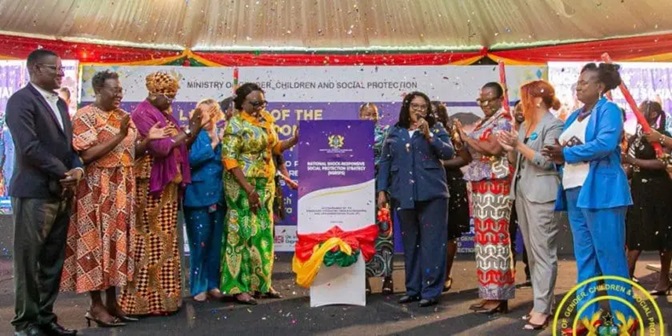
The Ministry of Gender, Children and Social Protection launched the National Shock-Responsive Social Protection Strategy (NSRSPS) in Accra this week, describing it as a shift from reactive crisis management to a more structured and anticipatory system capable of scaling up rapidly in times of need.
Speaking at the launch, the Minister for Gender, Children and Social Protection, Dr Agnes Naa Momo Lartey, said the framework is a practical response to the rising incidence of climate-related and economic shocks affecting livelihoods across the country. She added that the strategy is expected to improve coordination, enhance targeting, and ensure timely delivery of assistance to affected populations.
The minister cited recent examples highlighting Ghana’s vulnerability. In 2023, the Akosombo Dam spillage displaced more than 30,000 people across the Volta, Eastern, and Greater Accra regions, while severe flooding in 2024 affected thousands, destroying homes and disrupting livelihoods in parts of the Central and Northern regions.
Emphasising implementation, Dr. Lartey noted that the success of the strategy will depend on strengthening early warning systems, improving data infrastructure such as the Ghana National Household Registry, expanding digital payment platforms, and ensuring sustainable financing. She called for continued collaboration among government agencies, development partners, and civil society.
Director-General of the National Development Planning Commission, Dr Audrey Smock Amoah, also urged a transition from traditional preparedness approaches to more resilient, shock-responsive systems. She noted that the NSRSPS provides a coordinated framework supported by standard operating procedures and a clear implementation plan.
Development partners, including the World Bank Group, UNICEF, World Food Programme, the British High Commission, and the National Disaster Management Organisation, pledged technical and financial support for the rollout.
The launch brought together government officials, civil society actors, academia, traditional authorities, and the media, marking the culmination of a strategy development process that began with technical working sessions in late 2024 and a national validation workshop earlier this year.
The NSRSPS, alongside its implementation plan and operating procedures, is expected to guide the delivery of coordinated and timely support services to reduce the impact of crises on Ghanaians, particularly the poor and vulnerable.
Source: newsghana.com