
Fidelity Bank Ghana has reported another year of robust financial performance, posting significant gains in profitability, deposits, lending, and digital banking as it continues to strengthen its position as Ghana’s largest privately owned indigenous bank.
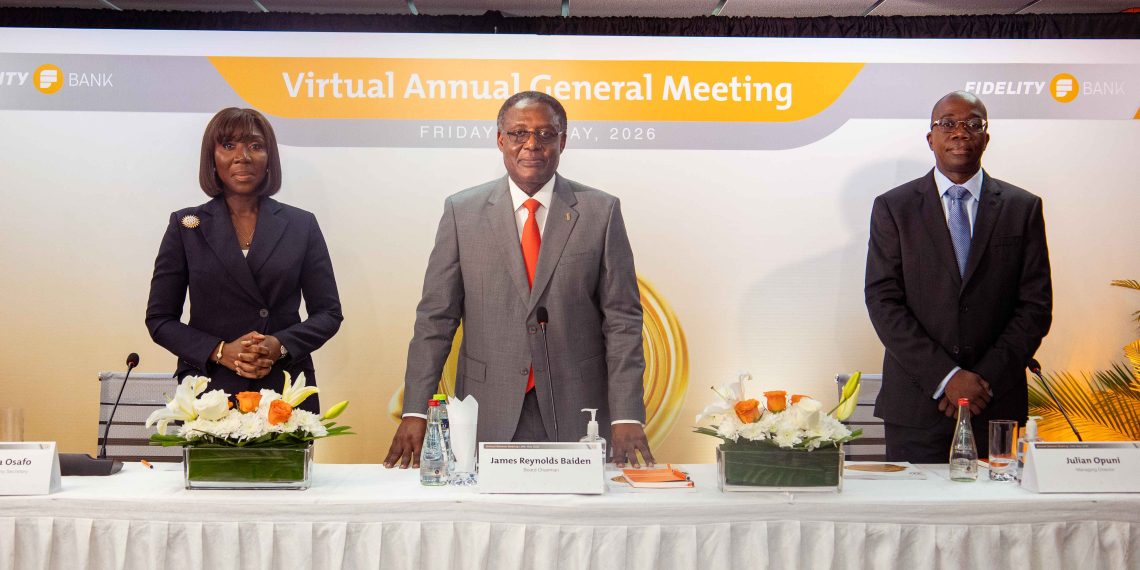
During its 2026 Annual General Meeting (AGM), the Bank announced record financial results for the year ending December 31, 2025. Board Chairman James Reynolds Baiden described the performance as exceptional, noting that it was achieved despite lingering global uncertainties and a challenging operating environment.
According to the Bank, Profit Before Tax increased by 21 percent to GH¢1.46 billion in 2025, up from GH¢1.21 billion recorded in the previous year. The growth was attributed to effective strategy implementation, operational resilience, and continued customer trust.
Operating income also rose by 14 percent, reaching GH¢2.68 billion compared to GH¢2.34 billion in 2024. The increase was driven by strong performance across both interest-based and non-interest income streams.
Fidelity Bank further recorded solid balance sheet growth, with total assets climbing 17 percent to GH¢25.98 billion. Customer deposits and wholesale funding liabilities increased by 13 percent to GH¢21.68 billion, reflecting growing market share across both corporate and retail banking segments.
One of the Bank’s standout achievements in 2025 was its lending performance. Gross loans and advances expanded by 51 percent, rising from GH¢3.14 billion in 2024 to GH¢4.74 billion. The Bank said this growth underscores its commitment to financing businesses, small and medium-sized enterprises, retail customers, and emerging sectors of the economy.
Managing Director Julian Opuni credited the results to disciplined execution, strategic expansion, and continued investment in innovation.
He noted that the Bank accelerated its transformation agenda through investments in technology, automation, analytics, and customer-centric digital solutions. According to him, digital platforms and data-driven capabilities remain central to delivering efficient, personalized, and reliable banking services.
The Bank also improved the quality of its loan portfolio, reducing its Non-Performing Loan (NPL) ratio to 7.09 percent, significantly below the industry average of 18.9 percent. Management attributed the improvement to prudent risk management practices and strong credit oversight.
Following regulatory approval from the Bank of Ghana, the Board declared a dividend of GH¢11.20 per share for shareholders.
Beyond financial performance, Fidelity Bank strengthened its sustainability and environmental initiatives during the year. The Bank provided more than GH¢170 million in financing for green businesses and climate-focused projects.
It also expanded programmes such as the GreenTech Innovation Challenge and Orange Inspire Creative Challenge, while its Waste-to-Cash initiative successfully recycled 14.7 tonnes of paper. Additionally, the Bank’s corporate social responsibility activities positively impacted more than 40,000 people across ten regions of Ghana.
The institution’s achievements earned it several prestigious local and international awards in 2025, including recognition as Best Private Bank in Ghana by Euromoney, Best SME and ESG Bank in Ghana by the Global Banking & Finance Awards, Bank of the Year at the Ghana Business Awards, and Ghana’s Best Bank for ESG at the Euromoney Awards for Excellence.
Looking ahead, Chairman Baiden expressed confidence in the Bank’s future prospects, reaffirming its commitment to innovation, digital transformation, operational excellence, and customer-focused growth.
The 2025 results reinforce Fidelity Bank’s growing role as a key partner in Ghana’s economic development, combining strong financial performance with sustainability, innovation, and inclusive growth initiatives.
Source: citinewsroom.com