

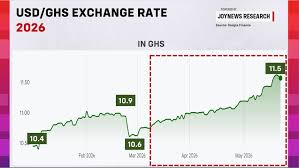
Ghana’s foreign exchange reserves reached their highest level in over a year in May, but the improvement has not been enough to stop the continued depreciation of the cedi, which remains under pressure from strong demand for dollars, dividend repatriation, and rising oil prices.
Data from the Bank of Ghana showed that gross international reserves increased to US$14.4 billion as of May 18, 2026, representing 5.7 months of import cover. This marks an increase from US$13.8 billion recorded at the end of December 2025.
The stronger reserve position came alongside an improved external balance, with Ghana’s current account surplus rising to US$3.10 billion in the first quarter of 2026 compared to US$2.43 billion during the same period in 2025.
Governor of the Bank of Ghana, Johnson Pandit Asiama, explained during the central bank’s 130th Monetary Policy Committee briefing that the gains were driven by strong earnings from gold and cocoa exports as well as steady remittance inflows, despite increased spending on services and investment income. However, despite the stronger reserves, the cedi has continued to lose value. According to the central bank, the local currency depreciated by 8.4 percent against the US dollar in the interbank market by May 15, while analysts estimate that losses have grown further in recent weeks.
Research firm Databank Research reported that the cedi’s depreciation had reached 10.11 percent by the third week of May due to persistent demand for foreign exchange. The currency was trading at around GH¢11.63 to the US dollar on the interbank market, while retail market rates weakened further to approximately GH¢12.20 per dollar.
Dr Asiama attributed the pressure on the cedi mainly to increased dollar demand from the energy sector and seasonal dividend payments by multinational companies. He stressed that the Bank of Ghana continues to conduct regular foreign exchange auctions to supply the market.
The governor also clarified that the central bank is prioritising reserve accumulation rather than extraordinary intervention in the foreign exchange market. According to him, the current approach is aimed at rebuilding reserve buffers after recent economic instability.
He disclosed that the central bank plans to inject about US$1 billion into the market this month through its twice-weekly FX auctions and assured banks that there should be no panic over dollar liquidity.
The report noted that the International Monetary Fund had previously expressed concerns about the scale of the central bank’s interventions in the FX market. In response, the Bank of Ghana introduced a formal Foreign Exchange Operations Framework that includes scheduled auctions and pre-announced monthly targets for licensed banks.
Databank Research suggested that the central bank’s cautious approach may be intended to preserve reserves while waiting for more stable foreign exchange inflows, especially amid ongoing market pressures.
Analysts believe the strategy reflects lessons from Ghana’s recent balance-of-payments crisis, when heavy reserve spending failed to prevent a sharp fall in the cedi and eventually led to an IMF-supported recovery programme.
Despite this, the continued depreciation of the currency raises concerns about inflation and fuel prices, particularly as tensions in the Middle East continue to keep global crude oil prices high.
Dr Asiama acknowledged that international developments remain a major factor affecting Ghana’s foreign exchange outlook, adding that any decline in global oil prices could help ease pressure on the cedi.
Meanwhile, market analysts say Ghana’s foreign exchange supply remains relatively strong due to high gold prices and ongoing gold purchases by the Ghana Gold Board from the small-scale mining sector. They added that the Bank of Ghana may be allowing the cedi to gradually adjust toward its market value while strengthening its balance sheet, although authorities could face pressure to intervene more aggressively if the weaker currency significantly increases inflation and fuel costs.
Databank Research forecasts that the cedi will trade between GH¢11.55 and GH¢11.86 to the US dollar over the next two weeks, depending on market demand and the level of foreign exchange supplied by the central bank.