
As Ghana joins the international community to commemorate World Children’s Day 2026, the United Nations Children’s Fund (UNICEF) has called for greater investment in children’s health, education, nutrition and protection to ensure that the country’s improving economic conditions benefit every child.
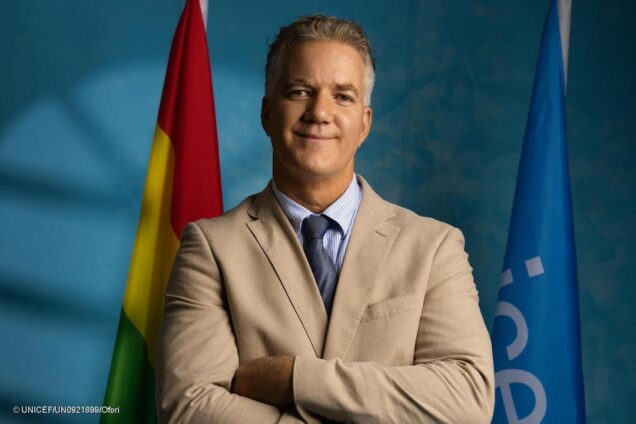
UNICEF Ghana Representative Andy Brooks has emphasised that although Ghana has made significant progress in economic recovery and child development, inequalities continue to prevent many children from accessing essential services.
In a statement marking World Children’s Day, observed annually on November 20, Brooks urged policymakers to prioritise investments that improve children’s lives, particularly those living in poverty, rural communities and underserved areas.
Ghana’s Progress in Protecting Children’s Rights
Ghana has a longstanding record of commitment to children’s rights, becoming the first country in the world to ratify the United Nations Convention on the Rights of the Child in 1990.
Since then, successive governments and development partners have implemented programmes aimed at improving child survival, education, healthcare and social protection.
According to UNICEF, Ghana has achieved a reduction of more than 70% in under-five mortality over the years, alongside improvements in access to healthcare and school participation.
However, despite these achievements, significant inequalities remain across different regions and socioeconomic groups.
Child Mortality and Education Inequalities Remain Major Concerns
UNICEF’s assessment reveals substantial differences in children’s living conditions depending on where they are born.
In the Greater Accra Region, under-five mortality is estimated at approximately 20 deaths per 1,000 live births, compared with 72 deaths per 1,000 in the Oti Region.
Educational outcomes also present challenges.
Available figures indicate that 45% of children have not acquired basic numeracy skills by Primary Four, while 32% have not achieved foundational literacy proficiency.
Child protection remains another concern, with UNICEF reporting that 94% of children experience violent disciplinary practices, 28% are involved in child labour and approximately one in six girls marries before reaching 18.
These statistics highlight the need for targeted interventions to ensure that national development reaches vulnerable children.
UNICEF Calls for Fairer Distribution of Public Resources
Andy Brooks has encouraged the government to examine how public expenditure benefits children across different age groups, income levels and geographical locations.
According to UNICEF, children aged zero to five receive approximately 10.9% of total public spending on children, despite early childhood being a critical period for physical, cognitive and emotional development.
The organisation also notes that children from wealthier households receive almost twice the public investment per person compared with those from the poorest households.
UNICEF believes that addressing these disparities will require greater investment in early childhood services and more equitable allocation of resources to disadvantaged communities.
2027 Budget Projects Increased Social Sector Spending
The government’s 2027 Budget provides an opportunity to strengthen investment in children’s development.
According to the figures highlighted by UNICEF, spending across core social sectors is projected to increase from GH¢84.5 billion in 2026 to GH¢103.7 billion in 2027.
This represents approximately 26.6% of the national budget.
However, the organisation has cautioned that debt servicing continues to place pressure on available public resources, with interest payments projected at nearly GH¢61 billion.
UNICEF maintains that responsible financial management and investment in children should be pursued together to support long-term national development.
Education Funding Increases, but Learning Quality Remains a Challenge
The education sector is expected to receive GH¢52.9 billion in 2027, compared with GH¢49.1 billion in 2026.
While welcoming the increased allocation, UNICEF has emphasised that improved funding must translate into better teaching, adequate learning materials and stronger educational outcomes.
The organisation has drawn attention to shortages of qualified teachers, particularly in rural schools.
According to the reported figures, rural schools have approximately 67 pupils for every qualified teacher, compared with the national average of 37.
UNICEF believes that addressing these inequalities will be essential to achieving the objectives of Ghana’s Foundational Learning Agenda 2026–2030.
Healthcare and Immunisation Require Sustainable Financing
Ghana’s health sector allocation, including the National Health Insurance Scheme and the Ghana Medical Trust Fund, is projected to increase from GH¢34.1 billion in 2026 to GH¢47.4 billion in 2027.
UNICEF has welcomed efforts to improve domestic financing for essential healthcare services, particularly childhood immunisation.
However, concerns remain over the adequacy of available resources.
The government has introduced a dedicated vaccine budget allocation of GH¢100 million, but UNICEF estimates that approximately US$54 million will be required to sustain the country’s immunisation programme.
This funding requirement is particularly important as Ghana prepares to assume full financial responsibility for its immunisation programme by January 2030 following its transition from Gavi support.
Water and Sanitation Challenges Affect Children’s Wellbeing
UNICEF has also highlighted inadequate access to water, sanitation and hygiene facilities in schools and healthcare institutions.
The organisation reports that 41% of schools lack basic water services, while another 41% lack basic sanitation facilities.
Similarly, 35% of healthcare facilities lack basic water services, and 46% have inadequate handwashing facilities.
These conditions can expose children to preventable diseases, undermine learning and compromise the quality of healthcare delivery.
UNICEF is therefore advocating increased investment in safe water, sanitation infrastructure and hygiene services.
Social Protection Programmes Need Additional Support
Programmes designed to reduce poverty and support vulnerable households remain essential to improving children’s living conditions.
UNICEF acknowledged that Ghana’s Livelihood Empowerment Against Poverty (LEAP) programme contributed to 226,000 households graduating from extreme poverty in 2026.
However, the organisation has raised concerns that the proposed GH¢1.1 billion allocation for 2027 may be insufficient to maintain existing support and achieve planned expansion.
An estimated funding gap of at least GH¢500 million could affect efforts to extend the programme to 470,000 households.
UNICEF has consequently called for stronger financial support for social protection programmes and initiatives that improve household livelihoods.
Child Protection Services Face Staffing Shortages
Protecting children from violence, exploitation, neglect and abuse remains a major priority.
According to UNICEF, Ghana currently has only 41% of the social welfare workforce required to provide adequate services nationwide.
This shortage limits the capacity of social welfare institutions to identify vulnerable children, respond to abuse and support families experiencing difficulties.
UNICEF has urged the government to strengthen frontline child protection services through increased staffing, operational funding and effective coordination.
UNICEF Calls for Smarter Investment in Ghana’s Future
As Ghana commemorates World Children’s Day, UNICEF is encouraging the government and development partners to ensure that economic recovery translates into measurable improvements in children’s lives.
Andy Brooks believes that investment in children should be regarded as a foundation for sustainable economic growth rather than merely an item of social expenditure.
He emphasised the importance of directing resources towards children who need them most, particularly during their earliest years of development.
The organisation maintains that healthier, better-educated and properly protected children will contribute to Ghana’s future workforce, entrepreneurship and national leadership.
Ultimately, UNICEF’s message is that Ghana’s economic progress must be reflected in the opportunities available to every child, regardless of family background, geographical location or financial circumstances.
Original Commentary: Andy Brooks, UNICEF Ghana Representative
Source: MyJoyOnline