
The introduction of Ghana’s newly redesigned cedi banknotes has sparked discussions about their potential economic benefits, production costs and long-term impact on the country’s financial system.
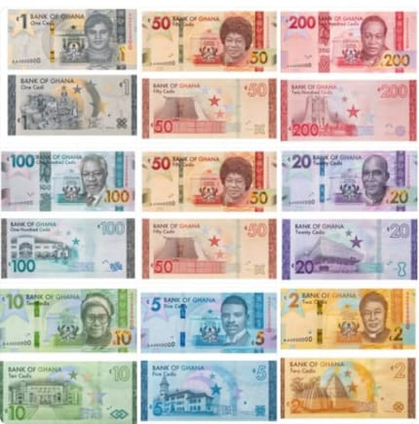
The new banknotes, officially known as the Ghana Cedi Heritage Series, were unveiled by President John Dramani Mahama on November 12, 2026, and are scheduled to enter circulation on December 1.
According to the Bank of Ghana (BoG), the redesigned currency incorporates improved security features, enhanced durability and designs celebrating Ghana’s historical and cultural identity.
However, questions remain about whether the changes will deliver meaningful economic benefits beyond giving the national currency a new appearance.
New Banknotes Celebrate Ghana’s Historical Figures
One of the most significant features of the Heritage Series is its recognition of prominent Ghanaians whose contributions have shaped the country’s development.
Each denomination features a distinguished personality associated with an important aspect of Ghana’s national identity.
The GH¢1 note honours market trader Agnes Oforiwa Tagoe-Quarcoopome, while the GH¢2 note celebrates Cardinal Peter Porekuu Dery for his contribution to religious freedom.
The GH¢5 note features educationist Dr J.E.K. Aggrey, and the GH¢10 denomination recognises pioneering female judge Justice Annie Jiagge.
Renowned composer Dr Ephraim Amu appears on the GH¢20 note, while Theodosia Salome Okoh, designer of Ghana’s national flag, is featured on the GH¢50 note.
Former United Nations Secretary-General Kofi Annan is celebrated on the GH¢100 note, with Ghana’s first President, Dr Kwame Nkrumah, appearing on the GH¢200 denomination.
The designs are intended to promote national pride while encouraging younger generations to learn about the individuals who contributed to Ghana’s history.
Will the New Cedi Notes Strengthen Ghana’s Economy?
Although the redesign introduces improvements to the physical currency, financial observers have emphasised that changing banknotes does not automatically increase their purchasing power.
The value of the cedi continues to depend on broader economic conditions, including inflation, exchange rate stability, productivity and confidence in the economy.
Osman Abdul Latif Cheboo, President and Founder of Youth Parliament Ghana, has welcomed the potential benefits of the redesign but cautioned against excessive expenditure.
He believes the exercise should demonstrate clear value for money and contribute positively to the country’s financial management.
The central concern is whether the expected benefits will justify the resources invested in producing and distributing the new currency.
Currency Redesign Raises Questions About Production Costs
Introducing new banknotes involves substantial financial commitments, including design, printing, transportation, public education and the gradual replacement of older currency.
Previous currency-related exercises in Ghana have required considerable expenditure.
The Bank of Ghana reportedly spent approximately GH¢89 million on the 2007 currency redenomination exercise.
Similarly, the printing of the GH¢100 and GH¢200 denominations introduced in 2019 reportedly cost US$8.97 million.
These historical expenditures have renewed public interest in the financial implications of the Heritage Series.
While the Bank of Ghana expects the improved durability of the new notes to reduce replacement costs over time, the total expenditure associated with the latest redesign remains an important issue for public accountability.
Enhanced Security Features to Combat Counterfeiting
A major objective of the new currency is to strengthen protection against counterfeit banknotes.
The Bank of Ghana says the Heritage Series incorporates advanced security features designed to make fraudulent reproduction more difficult.
These improvements are expected to help businesses, financial institutions and individuals distinguish genuine banknotes from counterfeit currency.
However, experts have emphasised that technological improvements alone may not completely eliminate counterfeiting.
Public education and awareness will therefore remain essential to ensuring the security measures achieve their intended purpose.
Cheboo has encouraged the central bank to use the introduction of the new currency as an opportunity to improve financial literacy, particularly among students and young people.
Accessibility for Persons With Visual Impairments
The redesign has also generated discussions about the accessibility of Ghana’s currency for persons with visual impairments.
Individuals with limited or no sight often experience difficulties identifying banknote denominations during everyday transactions.
Features such as tactile markings, distinctive note sizes and high-contrast designs can help improve accessibility.
The Bank of Ghana has introduced a digital application known as the Cedi App to educate users about the security features of the redesigned banknotes, including support for visually impaired individuals.
Nevertheless, accessibility advocates may expect the physical banknotes themselves to offer practical identification features that reduce dependence on digital devices.
Existing Cedi Notes Will Remain Valid
The Bank of Ghana has assured the public that the introduction of the Heritage Series will not immediately invalidate existing cedi banknotes.
Both the old and new notes will circulate simultaneously, allowing individuals and businesses to continue using their current currency without disruption.
Commercial banks are expected to withdraw older banknotes gradually as the new series becomes more widely available.
This phased approach is intended to ensure a smooth transition and prevent unnecessary pressure on the banking system.
Beyond Appearance: What Will Ghana Really Gain?
The success of the Ghana Cedi Heritage Series will ultimately depend on whether its promised improvements translate into measurable benefits.
Stronger protection against counterfeiting, longer-lasting banknotes, improved accessibility and greater public awareness could contribute to a more efficient currency management system.
However, the redesign will not independently address inflation, rising living costs or fluctuations in the cedi’s exchange rate.
As Ghana prepares to introduce the new banknotes on December 1, public attention is likely to remain focused on the cost of implementation, the effectiveness of the security features and the long-term value of the exercise.
For many Ghanaians, the central question remains whether the redesigned currency will deliver practical benefits that justify the investment.
Source: MyJoyOnline