
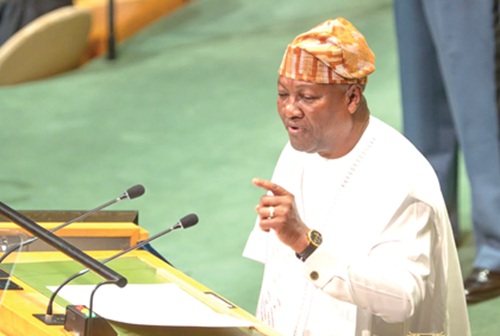
President John Dramani Mahama has called for equal and mutually respectful partnerships between Africa and the rest of the world, stressing that the continent is seeking cooperation rather than charity.
Addressing the United Nations General Assembly (UNGA) in New York, the President warned that Africa would not accept a return to a colonial-style model of resource extraction as global powers compete for the continent’s critical minerals.
He said Africa’s youthful population, arable land, cultural diversity and mineral resources placed the continent at the centre of the world’s future, but added that Africans must have a leading role in determining how those resources are used.
“Our continent possesses the world’s youngest population, vast arable lands, and parallel cultural vitality and the critical minerals required to drive the global green energy transition,” he said.
Warning against a new scramble for resources
President Mahama specifically mentioned lithium, cobalt, manganese, graphite and rare earths as critical minerals attracting growing international interest.
He warned that Africa should not become a passive participant in its own transformation and insisted that mineral extraction should create greater value within the continent.
“Let me warn. Africa will not remain a passive arena for a new scramble for resources.”
“Critical mineral extraction in Africa must not replicate the colonial-era exploitation. We will process our minerals at home. We will build local industries that create dignified jobs for our youth, and we will retain the value of our natural resources in Africa,” he said.
Call to dismantle structural inequalities
The President also urged the United Nations to address what he described as persistent structures that disadvantage Africa and the wider Global South.
He cited unfair trade practices, resource extraction, discriminatory credit ratings, unsustainable debt and the continued export of raw materials without sufficient value addition.
Referring to the adoption of the UN Resolution on Reparatory Justice, Mr Mahama said the resolution should result in changes to global governance and financial systems.
“Real repair demands structural transformation. It requires dismantling the persistent engines of exploitation, unfair global trade, predatory resource extraction, discriminatory credit ratings, unsustainable debt burdens of the Global South, and the continued export of raw materials from Africa, while real value addition and job creation occur elsewhere,” he said.
He said the resolution was necessary because, in his view, the structural consequences of slavery and other historical injustices continued to contribute to racism and economic marginalisation.
President Mahama welcomed what he described as positive steps by countries and institutions towards discussions on reparative justice, mentioning the Netherlands, Germany and France.
He, however, said dialogue alone would not be sufficient.
“Mr President, the injustices of the past remain embedded in today’s power structures,” he said.
Financing remains a concern
President Mahama also raised concerns about inequalities in the international financial system, saying developing countries and countries in the Global South could borrow at interest rates significantly higher than those available to industrialised economies.
He said African and Caribbean countries affected by climate-related disasters often had to incur additional debt to recover from floods and droughts.
“Governments are forced into a tragic choice to service predatory debts or to serve their people.
“We demand reform. We need long-term, affordable, and accessible concessionary financing that enables developing economies to invest in human capital, in industrialisation and climate adaptation,” he said.
Mahama renews call for permanent African seat on UNSC
President Mahama also renewed calls for reform of the United Nations Security Council, arguing that Africa’s absence from the permanent membership structure was inconsistent with the continent’s population and representation within the UN.
“Africa is home to 1.5 billion people, over 18 per cent of humanity, and constitutes the largest regional voting bloc in this General Assembly. And yet, Africa remains without a single permanent seat on the United Nations Security Council.”
He called for permanent African representation with the full rights and responsibilities attached to such membership.
“Africa must be granted permanent representation on the UN Security Council, complete with all the rights and responsibilities. We cannot credibly champion the sovereign equality of nations while preserving a global governance structure that was designed for the post-war geopolitical realities,” he said.
He described Security Council reform as important to the legitimacy and credibility of the UN.
Mahama condemns Gaza conflict
President Mahama also expressed concern about what he described as a deterioration in the global rules-based order, warning against unilateralism and the selective application of international law.
He condemned Israel’s actions in Gaza and the West Bank, while also condemning Hamas and its actions that preceded the conflict.
“The time has come for us to stop using diplomatic euphemisms to veil the human carnage that is taking place in Gaza.”
He said collective punishment, starvation and mass displacement constituted violations of international law.
Mr Mahama reaffirmed Ghana’s support for Palestinian statehood and a two-state solution that would allow Israel and Palestine to coexist in peace and security.
“Ghana remains unwavering in its recognition of the sovereign state of Palestine and its steadfast support for a viable two-state solution where Israel and Palestine will live side by side in peace and security, with guaranteed borders.”
He added:
“At the same time, we condemn all acts of terrorism by Hamas that triggered this conflict. And we insist that all parties unconditionally respect international humanitarian law. Our moral standards cannot be selective.”
Ghana renews call for lifting of Cuba embargo
The President also reiterated Ghana’s call for the lifting of the longstanding economic, commercial and financial embargo imposed on Cuba by the United States.
He further drew attention to the humanitarian situation in Sudan and worsening insecurity in the Sahel.
On the wider Middle East crisis, Mr Mahama said the conflict was affecting the global economy and called for renewed negotiations.
“We call for a return to the negotiating table. And let me add that no human civilisation deserves to be annihilated and certainly not a member of the United Nations,” he said.
Mahama urges African leaders to strengthen governance
President Mahama also challenged African leaders to strengthen governance and accountability at home while advocating for a more equitable international system.
He cited Ghana’s democratic experience as an example of constitutional governance and peaceful political transitions.
“As the legal maxim goes, whoever comes into equity must come with clean hands. African leadership must be transparent and accountable.”
He called for stronger action against corruption and more efficient use of public resources.
“We must commit to the fight against corruption and ensure that every dollar of our people’s money counts and is used efficiently in their interest,” he said.
Ghana’s economic turnaround
The President said Ghana’s experience demonstrated that democracy could deliver sustainable progress when supported by the rule of law and respect for human rights.
“Ghana is arguably the most stable democracy in Africa. We believe in the rule of law and have respect for human rights. And we are determined to demonstrate that democracy works.”
He said constitutional processes and broad participation could make progress slower but ultimately more sustainable.
Mr Mahama also pointed to Ghana’s upcoming 70th independence anniversary in March 2027 and the country’s planned assumption of the African Union chairmanship in the same year.
He said Ghana would use the AU chairmanship to advance industrialisation, regional integration and implementation of the African Continental Free Trade Area (AfCFTA).
The President further said his administration’s Resetting Ghana agenda was already producing economic results.
“Less than two years into my administration, through disciplined governance and fiscal prudence and an uncompromising fight against corruption, Ghana has achieved a dramatic economic turnaround.”
“Indeed, some circles describe it as a Ghanaian miracle,” he added.
He said measures implemented by the government had supported economic growth, reduced inflation, stabilised the cedi and lowered the public debt burden.
According to Mr Mahama, multilateral financial institutions and international credit rating agencies had also recognised the country’s economic recovery.
Big Push and 24-Hour Economy
He stressed, however, that macroeconomic stability alone was not sufficient and outlined the government’s infrastructure and economic transformation programmes.
These include the Big Push infrastructure programme, which he said would support road construction, digital connectivity, schools and health facilities.
He also highlighted the 24-Hour Economy and Accelerated Export Development Programme and the proposed New Ghana Economy Policy as initiatives aimed at increasing industrial production, value addition and job creation.
Mr Mahama said the government was supporting round-the-clock commercial operations, promoting value addition in agriculture and mining, and seeking to create sustainable jobs for young people and women.
He also highlighted the government’s social protection, universal healthcare and Sustainable Development Goals agenda, particularly SDGs 1, 3 and 10.
Free primary healthcare
The President said Ghana had launched a free primary healthcare programme aimed at ensuring that citizens could access essential primary healthcare services at the community level without paying fees.
“Ghana has officially launched a historic free primary healthcare programme, ensuring that every Ghanaian can access essential primary healthcare services at their community level at zero cost,” he said.
He said the programme had received recognition from the World Health Organisation and the United Nations as an approach relevant to health systems in the Global South.
source – www.graphic.com.gh